Ireland and the Atlantic Gap
Ireland and the Atlantic Gap
Why Europe’s Western Edge Is Becoming Strategically Critical
Ireland spent decades presenting itself as a politically neutral state at the edge of Europe – with limited strategic importance and therefore responsibility. That framing is becoming strategically obsolete. The island sits at the convergence of transatlantic digital infrastructure, critical energy systems, offshore renewable capacity, and strategic maritime routes. Its institutional preparedness has not kept pace but new ambitions are in sight.
The Position Has Changed — Whether Policy Has Caught Up or Not
Look at a map of transatlantic data cables and Ireland jumps out. The country sits precisely where the heaviest bundles from North America come ashore or head towards the Continent. Financial transactions, government communications, cloud infrastructure, military and civil coordination: a significant portion of the everyday life as we know it runs over fibres lying on the seabed off the Irish coast.
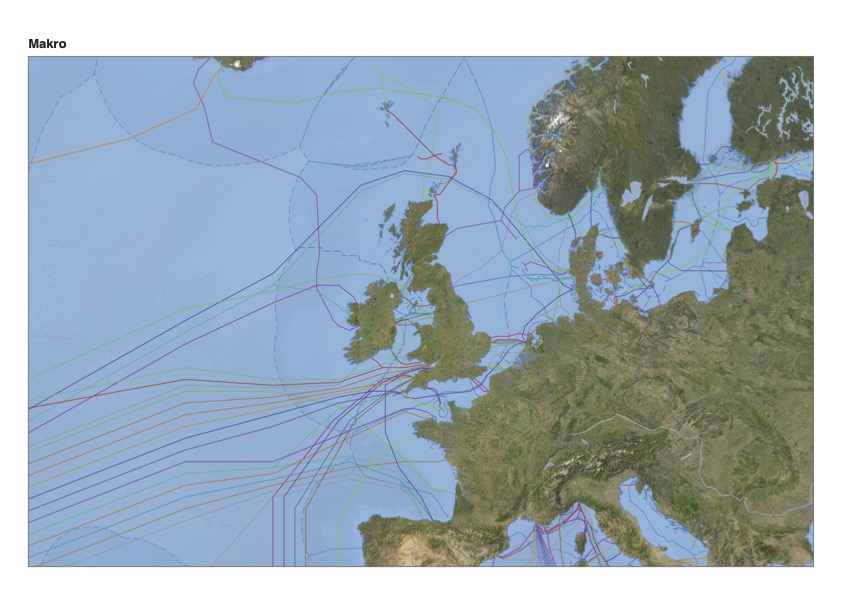
Add to that: the European headquarters of Amazon, Microsoft, Google and Meta, overwhelmingly concentrated in the greater Dublin area; the Celtic Interconnector, a 700 MW undersea electricity cable to France, still under construction; growing offshore wind capacity in the Atlantic; and an Exclusive Economic Zone of around 880,000 square kilometres (ten times the land mass) monitored by a Naval Service that is structurally underfunded and understaffed.
What was previously a footnote for defence specialists is now becoming a central strategic challenge facing the Irish state and a key infrastructure weakness in the EU.
Under the Atlantic: Infrastructure Nobody Sees
Over 95 per cent of international data traffic travels via submarine cables. These cables carry everything from streaming, banking data, diplomatic communications but also the operational backbone of the modern economy. And a disproportionate share of it lands in Ireland.
The European Commission documented in its report on the security and resilience of EU submarine cable infrastructures what analysts had long known: the cables are geographically concentrated, poorly monitored, and slow to repair when damaged. There are roughly 60 specialist cable repair ships globally, adequate for routine faults but not for coordinated attacks at multiple points simultaneously.
The CSIS Ireland case study is direct: Ireland’s role as a transatlantic cable hub creates concentrated exposure that has not been reflected in national maritime surveillance capability, critical infrastructure governance, or allied awareness.
“Ireland’s strategic importance derives less today from its geopolitical neutrality than from the density of infrastructure running over and under its waters.”
The Incidents Are Piling Up
None of this is theoretical any more. In November 2024, a Russian naval intelligence vessel was escorted away from undersea cables in the Irish Sea by British naval forces — an episode reported by The Guardian and widely noted in European security circles. What was notable was not just the event itself but who responded: Britain, not Ireland.
This fits a pattern. In the Baltic, cables and pipelines have been systematically damaged since 2022 — from Nord Stream to Finnish-German and Estonian-Finnish connections. The European Commission and several member states have responded. The EU coordinated risk assessment on cable security reflects that. Ireland has moved more slowly.
The problem is simple: threat environments do not wait for regulatory catch-up.
What the Navy Does — and Does Not Do
Ireland’s EEZ is the fifth largest in the EU. The Naval Service, responsible for monitoring it, has lost capacity in recent years through underinvestment, recruitment failures and fleet deterioration. The Commission on the Defence Forces was candid in 2022: this is not militarist overreach, it is the structural minimum for a state with Ireland’s exposure.
The National Maritime Security Strategy 2026–2030 acknowledges that. It names the risks and sketches coordination structures. But a strategy is not a result. The gap between strategic commitment and operational reality (surveillance capacity, interoperable communications, response capability) is large and will take years to close.
In the meantime, Britain largely fills the gap. That was formalised in March 2026 when Dublin and London signed a rebooted bilateral defence agreement explicitly covering cyber and undersea infrastructure in Irish waters. Operationally useful. Also a measure of what Ireland cannot yet do itself.
Data Centres, Electricity, and What They Have in Common
Ireland is Europe’s largest concentration of hyperscale data centres. AWS, Microsoft Azure, Meta, Google – their European headquarters and a substantial share of their operational infrastructure sit around Dublin. Data centres now consume more electricity than all Irish urban households combined, as documented by the CSO.
The Celtic Interconnector will improve energy resilience but it is itself an undersea cable, one that needs protecting. A strategic electricity asset crossing the Atlantic shelf that requires maritime surveillance Ireland does not yet fully have.
Regulation: Necessary, Not Sufficient
Ireland has transposed the EU’s Critical Entities Resilience Directive into national law via S.I. No. 559/2024. The NCSC’s 2025 National Cyber Risk Assessment is frank about the exposure. The regulatory framework is being assembled.
The real problem: compliance is not the same as resilience. An organisation can satisfy every legal requirement under S.I. 559/2024 and still be operationally fragile in ways no compliance framework is designed to detect. Resilience is a dynamic property of systems under stress – and systems that include undersea cables, cloud infrastructure, offshore energy and maritime traffic are complex enough that checklist-based governance will always lag behind reality.
Strategic Outlook
The Atlantic is not becoming less contested. The offshore wind sector, the Celtic Interconnector, data centre expansion, subsea cable concentration – all of it deepens Ireland’s strategic exposure over the coming decade. Ireland sits within the European security architecture but outside NATO’s collective defence framework. Its neutrality means allied maritime surveillance near Irish cables operates bilaterally, not multilaterally – creating coordination complexity that must be resolved through alternative institutional arrangements.
That exposure is also, managed seriously, an argument for Ireland’s centrality in European security. A state that takes its maritime responsibilities seriously and contributes to allied undersea infrastructure protection is not on the periphery of European security. It is one of its western anchors.
The strategy and European framework is in place. The question is whether the political will and institutional momentum as well as the backing in media and society exist to implement it at the pace the security environment requires.
Sources
- Government of Ireland: National Maritime Security Strategy 2026–2030
- European Commission: Security and Resilience of EU Submarine Cable Infrastructures
- CSIS: Strategic Future of Subsea Cables — Ireland Case Study
- NCSC Ireland: 2025 National Cyber Risk Assessment
- Commission on the Defence Forces
- NATO PA: Critical Maritime Infrastructure Report 2023
- RAND Europe: Evolving Threats to Critical Undersea Infrastructure
- UNIDIR: Achieving Depth — Subsea Cables as Critical Infrastructure
- EirGrid: Celtic Interconnector
- Irish Statute Book: S.I. No. 559/2024
- Council of the EU: Coordinated Risk Assessment on Cable Security
- The Guardian: Russian spy ship escorted from Irish Sea cables
- The Guardian: UK signs rebooted defence agreement for Irish waters
- Le Monde: Ireland, the weak link in Europe’s defence